

Folklore Tapes is an open-ended research project exploring the vernacular arcana of Great Britain and beyond; traversing the myths, mysteries, magic and strange phenomena of the old counties via abstracted musical reinterpretation and experimental visuals. The driving principle of the project is to bring the nation’s folk record to life, to rekindle interest in the treasure trove of traditional culture by finding new forms for its expression.
Friday, 2 June 2017
Industrial Folklore Tapes Vol.II - Springs
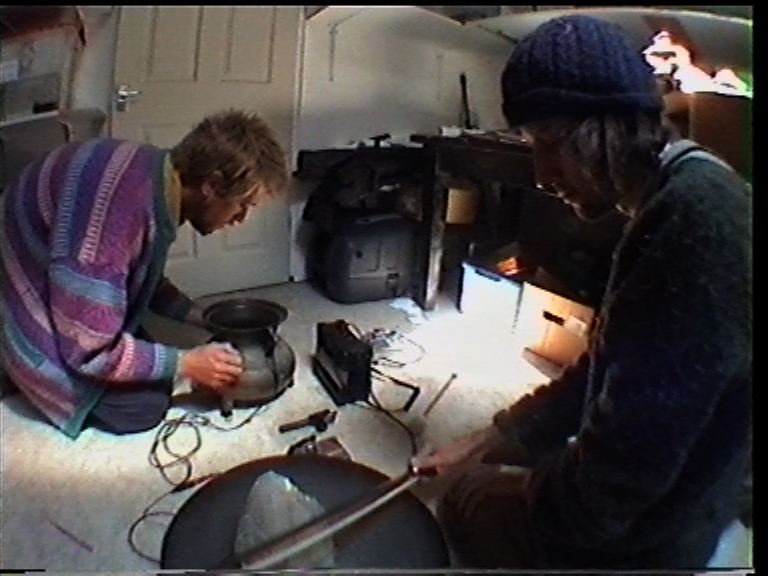
Bud holding his copy of Springs at BPS workshop, end of Spring, 2017.

Tuesday, 23 May 2017




Wednesday, 17 May 2017
Industrial Folklore Tapes
Folklore is most often associated with the romance of rural life, but this new series of releases explores ‘Industrial Folklore’, born from the hardship and daily toil of workers in mills, mines and foundries in the north of England. The Industrial Folklore series sets out to explore a recent past, embedded in family histories and still in living memory, yet for the most part a forgotten bygone era, that appears to have little connection to our present existence. It is no coincidence that the artists who begin this series are all based in and around Lancashire, the birthplace of the Industrial Revolution, a landscape silently haunted by the tangible remains of once thriving noisy industries.
Mary Stark, 2017


Monday, 1 May 2017

Saturday, 16 January 2016
Black Dog Traditions of England

Black Dog Traditions of England
Ian Humberstone, David Chatton Barker, et al.
- 12” LP featuring acousmatic sound compositions, site-specific field-recordings and original audio of local storytellers spinning out black dog yarns.
- DVD containing a 10-minute film by David Chatton Barker, hand-treated using haunted materials and distressed in rust, accompanied by a special mix of the project’s audio.
- Full-colour, 80-page book by Ian Humberstone, containing original articles focussed on each tale covered by the project, as well as photography taken on-site during fieldwork.
- Riso printed poster of Dob Park Lodge and Troller’s Gill—two locations featured in the project.
- All contents captured in an embossed, hand-numbered and hand-stamped box.
- Edition of 500 with first 100 copies containing an additional cassette version of the project audio. Available to pre-order here from Monday 18.01.16
What is a black dog? Well, that is a question more easily asked than answered. Listen close and I will tell you all that I know.
A black dog is a nocturnal terror, a prowling and ill-omened animation of the witching-hour. Whether plying its trade as a ghost or goblin, a demon or devil, its principle description remains—it is a horrid thing of prodigious size, black and shaggy-haired, in the rough shape of a dog (though greater in stature than any natural breed), with glowing eyes as large as tea saucers that glitter and gleam in the murk. Its recurrent associations are with death, misfortune and the darker shades to human endeavour.
These are dread-makers that lurk in the forgotten, twilit corners of this world: the lanes, crossroads and graveyards of isolated villages; the tumuli, ruins and ravines of the open moors; the site at which a gibbet stood or murder was committed in more populous places. They are wont to wander. Those associated with a particular road or lane are often said to patrol a certain stretch or ‘beat’ along it, while those that once haunted a specific site have frequently expanded their activities to a surrounding locale, as their story waxes in its retelling.
These are unholy-hounds that stalk their sorrowful haunts at dusk or midnight—those liminal hours when the darkling night might shelter their fetid furs. A black dog may appear or disappear instantaneously, mutate at will, shrink or swell in size, emit a sulphurous stench, even trail a great clanking chain behind it as it goes. It may howl and yowl, or roar and rumble, shrieking and screeching through the squally night. Or it may be silent, save for the unpropitious padding of its giant paws upon the ground behind.
How long, exactly, these deliria have tottered along in mankind’s wake is uncertain. In their most basic construction—black, ill-defined, malevolent creatures of the beyond—they are likely as ancient as human fear itself. Yet each generation has added to the image, creating a shifting, legendary mongrel-breed, charged with myth and story.
A black dog is a nocturnal terror, a prowling and ill-omened animation of the witching-hour. Whether plying its trade as a ghost or goblin, a demon or devil, its principle description remains—it is a horrid thing of prodigious size, black and shaggy-haired, in the rough shape of a dog (though greater in stature than any natural breed), with glowing eyes as large as tea saucers that glitter and gleam in the murk. Its recurrent associations are with death, misfortune and the darker shades to human endeavour.
These are dread-makers that lurk in the forgotten, twilit corners of this world: the lanes, crossroads and graveyards of isolated villages; the tumuli, ruins and ravines of the open moors; the site at which a gibbet stood or murder was committed in more populous places. They are wont to wander. Those associated with a particular road or lane are often said to patrol a certain stretch or ‘beat’ along it, while those that once haunted a specific site have frequently expanded their activities to a surrounding locale, as their story waxes in its retelling.
These are unholy-hounds that stalk their sorrowful haunts at dusk or midnight—those liminal hours when the darkling night might shelter their fetid furs. A black dog may appear or disappear instantaneously, mutate at will, shrink or swell in size, emit a sulphurous stench, even trail a great clanking chain behind it as it goes. It may howl and yowl, or roar and rumble, shrieking and screeching through the squally night. Or it may be silent, save for the unpropitious padding of its giant paws upon the ground behind.
How long, exactly, these deliria have tottered along in mankind’s wake is uncertain. In their most basic construction—black, ill-defined, malevolent creatures of the beyond—they are likely as ancient as human fear itself. Yet each generation has added to the image, creating a shifting, legendary mongrel-breed, charged with myth and story.

Black Dog Traditions of England tells the tales eight spectre-hounds in an expansive, multi-disciplinary box-set. It is the product of extensive fieldwork conducted by Ian and David throughout 2015, as well as Ian’s own researches into black dog folklore dating back to 2007.
The LP features acousmatic sound compositions, site-specific field-recordings and original audio of local storytellers spinning out their black dog yarns. The hand-treated and rust-degraded film contained on the DVD incorporates materials gathered in the field, such as ashes from the fireplace at Dob Park Lodge (above) and scorched waterweed from Troller’s Gill. The project book is notable in its own right—a detailed, original study tracing the history of each black dog story from its earliest textual source to the present day. The book also includes a map and full-colour photographs from the project’s many expeditions. An embossed, hand-numbered and hand-stamped box holds the contents firm.
The box-set is a reliquary of objects, stories and sounds centuries, if not millennia, in the making. These are resonances of the never-was: artworks informed by those long-forgotten who, out lurking in the half-light of a country lane, saw shapes somehow darker than the surrounding night that preyed upon their idle minds.
LP Tracklisting
- Black Dog Summons
- The Barguest of Dob Park Lodge
- The Black Dog of Uplyme
- The Legend of Black Vaughan
- The Procession at Black Dog Village
- Tales of Black Shuck
- The Barguest of Troller’s Gill
- The Black Dog of Newgate
- Watchdogs of the Wambarrows
Black Dog Traditions of England - The Barguest of Troller's Gill from Folklore Tapes on Vimeo.
Thursday, 3 December 2015
FTCCIII: Mid-winter Rites and Revelries

Folklore Tapes Calendar Customs Vol.III: Mid-Winter Rites & Revelries
Artists: Various
Format: Embossed cassette box including printed green cassette. screen printed sleeve, research booklet, essay, evergreen bough, poster, download code.
Release Date: 04/12/15
Edition: 250
Tracklist:
Arianne Churchman - Fourth Solo Cutty Wren Ritual
Dean McPhee - The Devil's Knell
Rob St John - Fire Rites
David Chatton Barker - Wheel of Life
Sam McLoughlin - Tangerines in Socks
Magpahi - The Lady of the Mountain
Mary Stark - Holly & Ivy
Ian Humberstone - Carrying the Clavie Fire
Carl Turney & Brian Campbell - lo Saturnalia!
Mary & David - Wassailing
Mid-winter is the low ebb of the year, the heart of the lifeless
season when the sun describes a wearily flattened arc across the sky:
its luminosity dimmed and wan, its passage brief. Shadows lengthen,
branches grow bare and bony, temperatures drop and darkness prevails.
There is a need for cheer, for hope and conviviality, for reminders of
Spring’s renewal to come. Old mid-winter rites and rituals, centring
around Christmastide observances and celebrations, bring a little warmth
and light to this chill time of scarcity and spiritual despond. And it
is these rites to which Folklore Tapes turn their collective eye in this
the fourth season of the solar year.
The artists contributing to this limited edition cassette compilation
have each researched a particular mid-winter ritual and, informed by
their findings, conjured a sound piece in response. The movements take
their listener on an audiological journey around the old ways of winter,
with acousmatic carolling, text-sound collage, composed music and
augmented field-recording. These are playful retellings of
long-forgotten observances: library sounds, carried on a wisp of smoke
from the bonfires of winters past.
The cassette comes housed in a hand-numbered and stamped box,
accompanied by a detailed booklet and essay focussing on the customs and
rituals covered. Also inside is a poster and evergreen bough to cheer
the peruser through the long, dank night. So come gather round the
ceremonial fire as Folklore Tapes toll the Devil’s knell, hunt the
sacred wren, light the Yule Log and enact saturnalic mischief in the
deepest depths of winter’s long night.
Available from the Folklore Tapes shop.
Friday, 11 September 2015
Folklore Tapes at the Arnolfini, Bristol, September 12th

Tomorrow, at the Arnolfini in Bristol, Folklore Tapes present a full evening of acts, including a one-off performance focusing on the stone circle at Stanton Drew, as well as spectral projections, tape manipulations, storytelling and light puppetry.
Sunday, 26 July 2015

Friday, 12 June 2015
Black Dog Field Notes

Ian Humberstone navigates Troller's Gill in the Yorkshire Dales. This limestone gorge is said to be the spot where a wizard met his maker at the muzzle of a barguest. The tradition is long-standing in the district, and commemorated by a ballad dating to the early nineteenth century.

The Wambarrows on Winsford Hill in Somerset. These ancient tumuli are rumoured to conceal a hidden treasure, which is guarded by a ghostly black dog. The phantom is said to appear on autumn nights, its saucer eyes glowering in the gloom. Approach it and death will follow, stand motionless and the vision will slowly fade away into the moorland mists.

Arianne Churchman's notebook, laid out on a table at the Locks Inn, Geldeston. In the nineteenth century, a 'Hateful Thing' in the form of a black dog, but keeping no regular shape or size, appeared near here to a mother and daughter. The daughter took great fright at the apparition, but the mother at first saw nothing - it was only on touching her daughter's hand that the creature revealed itself to them both. Great significance was placed upon the fact that the daughter was born 'under the chime hours' and could therefore see things others couldn't.

David Chatton Barker takes a break at Black Dog village in Devon. A black dog was said to haunt the well here at the time of the Civil War. More recently, a procession, involving guisers decked out in a black dog costume, was set up in the 1990s to honour similar reports of 'a beast' seen along the local roads.

The black dog weather vane in Bungay, Suffolk. On the fourth of August, 1577, a great tempest occurred here during divine service at St. Mary's church. A contemporary pamphlet records that in the midst of the storm a black dog, or 'the devil in such a likenesse', ran about the church assaulting the parishioners. Several are said to have been slain by the creature, which caused one man to shrivel up like a piece of leather 'scorched in a hot fire'. The Black Dog of Bungay has since become a local emblem.

The interior of Dob Park Lodge, an austere Tudor ruin overlooking the Washburn Valley near Harrogate. Legend tells us that in the foundations of this old manor there are a number of hidden passageways and chambers. It is said that deep down within the subterranean lair there lives a talking barguest that guards a chest of gold from any foolhardy enough to seek it.
Monday, 27 April 2015
Merry May: 'Minehead Hobby Horse' Research Notes

The Minehead Hobby Horse: An Awakening - Becoming Horse/Boat/Myth - Horseplay
The horse is awoken; the rider begins their process of becoming animal, their body assimilated into the horses.
May Day, Becoming Horse/Boat/Myth:
Beginning at 5am the awoken horse perambulates the old borders of the town, processing from the Quay to Whitecross and then to Dunster Castle. The act of boundary marking reinforces an insular space in which non-human becomings can occur and the myths shared by the community can be invoked. This is particularly evident in the strange shaping of the horse, though technically a horse it is also unmistakably boat shaped, a shape that invokes the myth of an unmanned ghostly ship entering the harbour and another myth of Viking invaders being chased back into their boats by the town’s populace dressed as this strange beast. The horse through its becoming other acts as the representative of the community and its shared history.
The Bootie, Horseplay:
The assimilation of the rider leads to “horseplay” and chaos, which is particularly evident during the Bootie at Cher. A spectator is caught by two members of the Hobby Horse team, and is booted ten times. The spectator then has to avoid the whipping of the horses tail afterwards in a dance.
“There is a becoming-animal not content to proceed by resemblance and for which resemblance, on the contrary, would represent an obstacle or stoppage”, Deleuze and Guattari (A Thousand Plateaus, 1988).
- Arianne Churchman
http://ariannechurchman.tumblr.com/
Sunday, 19 April 2015
Folklore Tapes Calendar Customs Vol.II: Merry May

Title: Folklore Tapes Calendar Customs Vol.II: Merry May
Artists: Various
Format: Embossed cassette box including screen printed cassette sleeve, research booklet, essay, maypole ribbon, download code.
Release Date: 01/05/15
Edition: 250
Estimated shipping: 24/4/15
Side A:
Carl Turney & Brian Campbell – SumerIsIcumenIn
; The Blue Funz - Beltane, Isle of Mull: Need-Fire and Milking Cows Through Cake
; Arianne Churchman - Minehead Hobby Horse ; Rob St John - Bringing in the May. Side B:
Ian Humberstone - The Hunting of the Earl of Rone
; Mary & David - Wish Before Sunrise (May Dewing)
; Children of Alice - Rite of the Maypole: An Unruly Procession
; Sam McLoughlin - I Want to Sing like the Birds Sing, Not Worrying About Who Hears or What They Think
; Malcolm Benzie - Hawthorne
Unite and unite and let us all unite,
For summer is a-come unto day
And whither we are going we will all unite,
In the merry morning of May.
For summer is a-come unto day
And whither we are going we will all unite,
In the merry morning of May.
May Day is one of the turning
points of the year, when the transformation from winter to spring is
ritually observed and celebrated. The Eve of May displays an obverse
face to Halloween’s soot-blackened mask, fixed on the opposite arc of
the annular globe. Both have origins in the Celtic pastoral year and the
solar festivals which lent it formal division. Superstitions
surrounding May Eve, May Day and the ensuing days at the start of the
month persisted well into the medieval period, and even into the
post-Reformation era. Fairies might steal or sour milk, or witches spell
maleficent harm on the herd.
May Day festivities are all about getting outdoors and inhaling the
first breath of summer; throwing the windows wide and heading for the
woodlands and meadows with a light skip in the step. The custom most
widely associated with May Day is the bringing in of the May. Boughs of
blossoming hawthorn would be cut and brought back from meadow’s edge and
strewn about town or village, some woven into garlands, others left as
they were found. Maypoles were erected in villages, towns and cities.
These towering columns would be painted with colourful stripes and hung
about with ribbons and flowers. They became the focal point for local
festivities, for dancing, whether in a wheeling, handlocked circle or
weaving approaches and evasions. Morris dancing featured frequently, and
there might be pipers and harpers, drummers and Fools to fuel the
festivities with music and general jollity. Mummers plays were sometimes
staged, the performers disguised, which gave them a certain license to
mock the high and mighty. Parades were peopled by stock figures of
British folklore, religious devotion and popular legend: George and the
Dragon, regional saints, Jack-in-the-Greens, Giants and Devils.
‘Merry May’ explores this world of Spring carousing sonically, with
contemporary music and sound informed by specific age-old traditions.
The artists contributing to this compilation have each researched a
particular May ritual and, informed by their findings, conjured a piece
in response. As such, the cassette takes its listeners on an
audiological journey where, mounted upon clacking Hobby horses, they
will meet with May Birchers and Dewers, reel around Maypoles and parade
the streets in the company of the Earl of Rone and the Fool.
Now available to pre-order from http://folkloretapes.co.uk
Thursday, 12 March 2015
Upcoming Project Announcement: Black Dog Traditions of England
.jpg)
Black Dog Traditions of England
Ian Humberstone and David Chatton Barker
Folklore is a kingdom unto itself, a world in which the past and the present, fact and fiction merge as one. The creatures that inhabit this wild and unkempt land are legion, the workings of many imaginations, with forms and powers cut roughly by the fireside and alehouse gossips of ages past. Our forthcoming series ‘Occultural Creatures’ presents these preternatural pests in the style of a radio ballad, with interviews, stories, acousmatic music and geographically informed sound-divination. Each edition will be housed in a presentation box containing an LP, book, map and short experimental film. We begin with ‘Black Dog Traditions of England.’
And a dreadful thing from the cliff did spring,
And its wild bark thill’d around—
Its eyes had the glow of the fires below—
‘Twas the form of the Spectre Hound!
Many and varied are the tales told of the black dog. To some it is a lane-haunting spectre whose appearance precedes a death, to others, the spirit guardian of thresholds or hidden treasures. Elsewhere still, it is none but a devil loosed of its chain, working evil in the realm of men. Yet wherever we catch a glimpse of this hound’s shadowy form, it is described in similar terms - as a dark entity in the shape of a great dog, with shaggy mane and tea-saucer eyes burning bright as hellfire.
Shuck, Shock, Skriker, Padfoot, Trash, Gytrash, Barguest, Hooter: there are many regional variations on the motif, each with their own traditions and stories. These four-footed beasts of the witching hour have kennelled themselves in the dimmer corners of our imaginations for centuries; how long, exactly, is a matter of debate.
Folklore Tapes’ Ian Humberstone has been researching these legends for more years than he cares to remember. Joined by David Chatton Barker, this study is being translated into an audio-visual format for Folklore Tapes. The pair are now wending their way about the country, collecting stories and field recordings from those places the hound has poked its fiery maw.
Folklore Tapes’ Ian Humberstone has been researching these legends for more years than he cares to remember. Joined by David Chatton Barker, this study is being translated into an audio-visual format for Folklore Tapes. The pair are now wending their way about the country, collecting stories and field recordings from those places the hound has poked its fiery maw.
Work in progress. Expected autumn, 2015.
Friday, 6 March 2015
Wizard's Will Promotional Copy at The Wizard's Well
Hidden behind the Wizard's Well can be found a promo copy of the Wizard's Will Flexi Audio Book
 |
| OS Grid Reference - SJ 858 778 |
Sunday, 22 February 2015


Thursday, 12 February 2015


Monday, 1 December 2014
Devon Folklore Tapes Volume One - Two Witches (Archival Reissue Series)
Folklore Tapes Archival Reissue Series:
Ian Humberstone / David Chatton Barker
Devon Folklore Tapes Vol.I
Two Witches
Twin Ten-Inch Gatefold Edition
Contains 2x 10" Records & 12page Research Booklet & Download Code
Housed in manilla hand stamped & numbered paper sleeve
Ltd Edition: 500
‘Two Witches’ is where it all began. This inaugural volume resulted from a postal correspondence between David Chatton Barker and Ian Humberstone in 2011, and was released as a split cassette housed in a hollowed-out hardback book later that year. Long out-of-print and highly sought after, the original recordings have been completely remastered for this lavish reissue, which is presented as a double ten-inch vinyl sited in a gatefold sleeve, complete with expanded research notes and artwork. This release is the definitive edition and marks the beginning of a wider reissue series for Folklore Tapes’ back catalogue, further editions of which will arrive throughout 2015.
The release itself provides a sonic impression of two long-forgotten figures from Devon lore: Hannah Henley and Mariann Voaden. Though they never met, both women lived in rural Devon during the nineteenth century and fostered highly idiosyncratic careers in the provision of charms and curses, at a time when belief in the reality of witchcraft was in decline. Hannah and Mariann were thus engaged in an age-old profession experiencing its death throes, the last in a long line of wizened crones to provide their neighbours with folk-remedies and blessings, to threaten them with hue and cry.
Building upon the scanty historical record, these recordings recreate the world of Hannah and Mariann as a living soundscape, giving flesh to the bare bones of their stories. Through acousmatic sound and composed music, Hannah’s curses recover their voice in the night. With rumbling thunder and detuned harmonium, the wind blows once more through the walls of Mariann’s crumbling cottage. And in the gathering dark, through the whirls and rattles, the creaks and drones, the tales of the long since departed might live and breath again.


Friday, 31 October 2014
Folklore Tapes Calendar Customs Vol.I - Fore Hallowe'en

Featuring:
Eva Bowan
Bokins
Mary Stark
D.Orphan
Children Of Alice
Ian Humberstone
Snail Hunter
Magpahi
Carl Turney & Brian Campbell
Rob St John
Whatever names they take today, many of our most venerable calendar dates have their origins in pre-Christian observances, often marking key points in the agricultural year when planting began or harvesting was completed. Mayday, with its dances, games and fertility ceremonies, is a fine example, reflecting the gratitude of an agrarian society for the sun’s rebirth and the bounty of the soil. Songs, games and rites often form an essential part of these occasions, and their echoes reach us today though the din of the ages, with hidden meanings and garbled messages. Our new Calendar Customs series attempts to explore this world of symbolism and ritual sonically, through research and artistic reinterpretation. We begin the series with fright night. Halloween.
If we cast our gaze back far enough, we can see the origins of today’s Halloween in the Celtic festival Samhain or Samuin (pronounced ‘sow-an’ or ‘sow-in’). This ancient, pre-Christian observance marked summer’s end and heralded the dark, winter nights to come with feasting, fire and sacrificial offerings. As a borderline festival between seasons Samhain was a time of supernatural intensity, when the boundaries between worlds were at their most porous and the souls of the dead might mingle with those of the living. Though much is lost to the murk of time, it also seems that at Samhain great bonfires were lit to both honour and guide the dead, as well as ward off such spirits and sprites as might be abroad that night.
Although the festival was Christianized in the fourth century, it never lost its predecessor’s supernatural flavour. Now linked to the holy days of All Souls’ and All Saints’, Hallowtide - as it became known in England - was a feasting day marked by prayers for lost souls in purgatory, but one which retained dark associations. Church bells were rung and bonfires lit to ward off demonic agency, while requiem masses were held to prevent the dead from returning to rectify wrongs committed against them while alive. From the Middle Ages, these solemn rites were joined by the carnivalesque, and Hallowtide became a season of masking and misrule, when ribboned mummers, guisers and Hobby horses could upturn the social norms. While the games and rituals of Hallowtide were attacked by the Protestant Reformation, many popular customs such as ‘Souling’ and ‘Lating’ continued, especially in the more Catholic northern areas.
By the time we arrive at the name Halloween in the eighteenth century, many of these traditions have subsided, though the night retains its reputation as a time when ghosts, spirits and witches might be abroad. At Dorstone in Herefordshire, one brave enough to stay the night in the local church would be greeted by the spectral forms of all those in the parish fated to die in the next twelve months. In Lancashire, burning candles were carried during the hour before midnight and if kept aflame throughout the witching-hour, the bearer would earn one year’s immunity from witchcraft.
While the customs may change, they retain at their core an unyielding association with the supernatural, with death and the departed: the hidden otherworld beyond our senses. So many of these traditions are lost in the fog of today’s heavily marketed and Americanized Halloween. This tape will pick out a few vestiges from the festival’s past, rekindling the fires that burned Fore Hallowe’en


Sunday, 22 June 2014


Subscribe to:
Posts (Atom)